
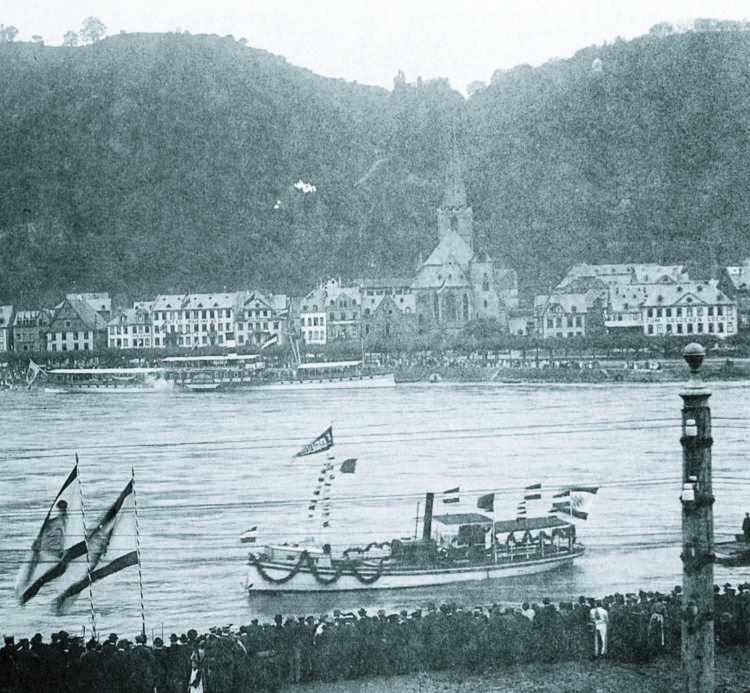
Already the Celts and Romans used to cross the Rhine using small wooden bridges made from tree trunks and attached to wooden planks when necessary. In the Middle Ages, the guardians of St. Goar, the counts of Katzenelnbogen, had the right to ferry people across the river.
In 1532, a ferry, the so-called Gierfähre, was used for the first time to travel along the Rhine river using the flow of the river.. This advanced ferry model consisted of two flat boats, the Nachen, with an intermediate loading platform, the Ponte. This was anchored with a long chain extending from bank to bank in the middle of the river. The heavy chain was secured against sinking by several small boats, the Buchtnachen. The force of the current propelled the ferry at high speed from one bank to the other, earning it the name ‚Flying Bridge‘. A fortune teller at the Burg Katz regulated shipping traffic: If a ship sailing down a river valley came along, the Flying Bridge in St. Goar had to be used; for mountain bikers in St. Goarshausen. With interruptions, the Flying Bridge connected the two banks of the Rhine for almost 300 years; it was only in 1794 that the French occupation forces put it out of service. From 1794 to 1867, ferry operations were maintained with wooden ferry boats.
In 1868, the first modern steam ferry, the ‘Loreley I‘, took over the ferry connection between the cities of St. Goar and St. Goarshausen. In line with the growing demands on ferry operations, new ships were commissioned at intervals of approximately 25 to 30 years, including the ‚Loreley II‘ to ‘Loreley VI’. The latter has been connecting the two riverfront cities since 2003.