
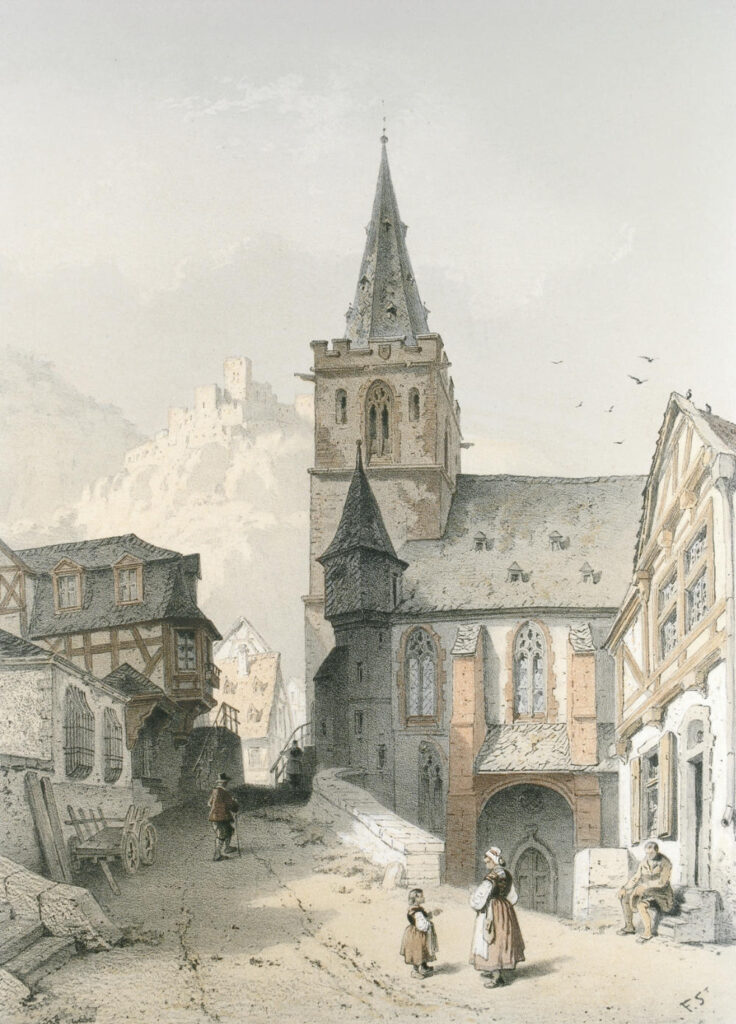
Various places of worship already stood at the site of today's Evangelical Episcopal Church of St. Goar. Where once Saint Goar The Abbey of Prüm had built a new church between 772 and 781, where his chapel had been erected and where his tomb vault was also located.
After repeated fires and renovations, between 1444 and 1469 the nave of today's cathedral church was rebuilt. Count Philipp von Katzenelnbogen, The church was built on the Rheinfels Castle. It is a late Gothic three-aisled nave with an attached west tower, which is characteristic of Gothic church architecture on the Middle Rhine. The Romanesque hall crypt from the 11th century, in which the tomb of Saint Goar was located, remained intact and is thus today the oldest part of the church. The late Romanesque-early Gothic choir with its flanking towers dates from around 1250. The Langhaus painting was created between 1469 and 1489. This makes the cathedral church the most significant site of late Gothic wall paintings on the Middle Rhine.
In 1527, in the town of St. Goar, under Count Philip I of Hesse the Reformation was introduced. St. Goar is thus the oldest evangelical parish in the Rhineland.
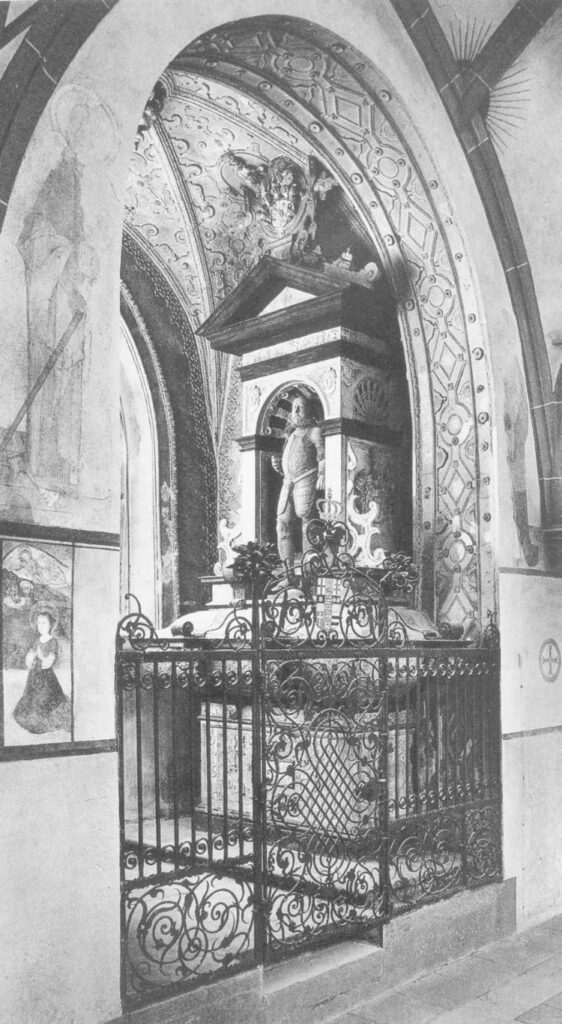
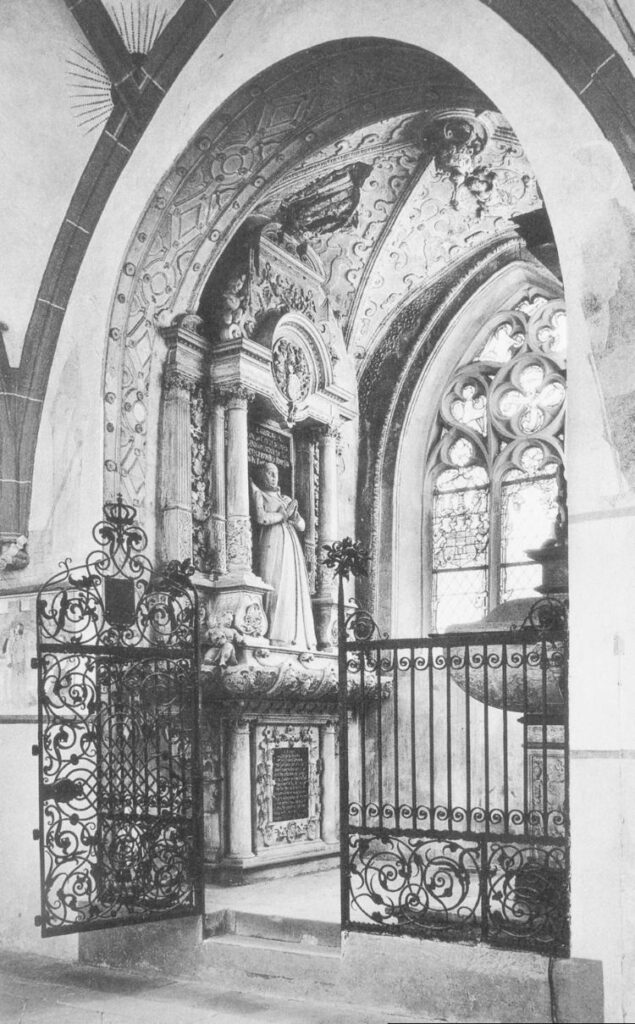
Among other things, the cathedral church contains the Paintings of Landgrave Philip II of Hesse-Rheinfels and the Countess Anna Elisabeth of Bavaria. The church commemorates the city's founder, Saint Goar, with, among other things, a depiction on the pulpit and, in the northern side chapel, an image on a finial stone and stained glass windows. The organ from 1820 is by the famous organ builder family Stumm.