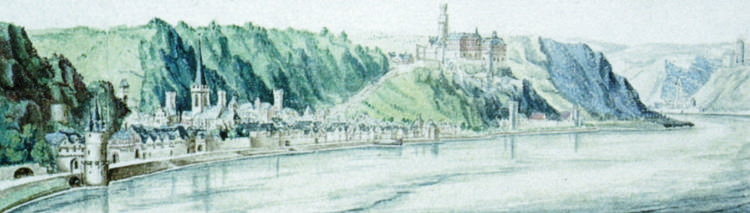
In the past, a ring-shaped city wall St. Goar, access was only permitted for authorized personnel through the secured gates. The town gate upstream was integrated into the crenellated wall. It was flanked by a three-story round tower projecting into the Rhine, which, in addition to a conical roof, supported several small towers.
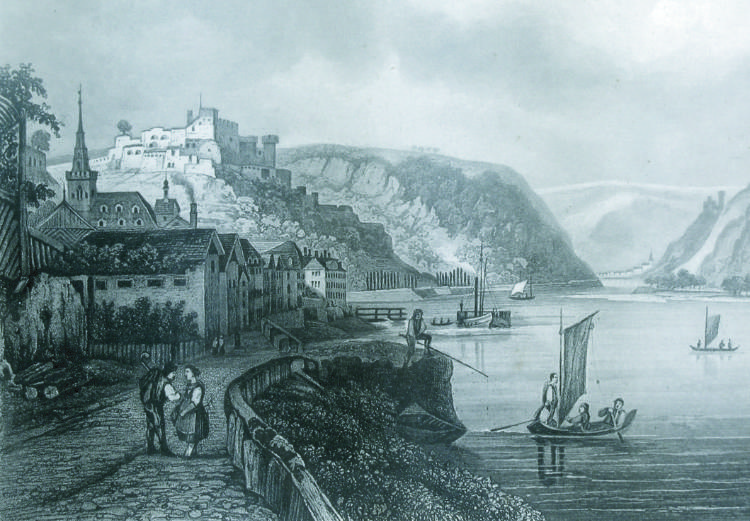
During the Napoleonic period, the city wall along the Rhine side was demolished to make way for the expansion of the city. Rheintalstraße, the Napoleon route, To create a new area. The mighty round tower also fell victim to the demolition; however, the foundation protruding into the Rhine remained intact for the time being. The stump came to be known in the local vernacular as the ‚Türmchen‘. Part of the city wall was also built on the foundations; for example, the house on Heerstraße 33, located opposite the ferry entrance, is based on remains of the eastern city gate. The name ‚Vor dem Türmchen‘ for the eastern part of the area still evokes the imposing tower that protected the city for centuries.
Not far from the historical city boundary is located the ‚Loreley House‘ one of the oldest surviving residential buildings in the city. There are also remains of the Rhine-side city wall in the foundation of this building. In this house, the The Lurley romance by Julius Wolff According to legend, Loreley spent her youth after the owner of the house, the fisherman Peter Sandrog, pulled her out of the Rhine while she was fishing as a child.