Unlike the other side streets, the Schleiergasse is home to numerous historical depictions: The house named after it, built in 1682 by Hospital Master Johann Heinrich Maul in a richly decorated half-timbered style and named after him at the lower end of the street, and the direct view of the city fortifications’ office tower make the alley a popular motif for romantic city views for generations.
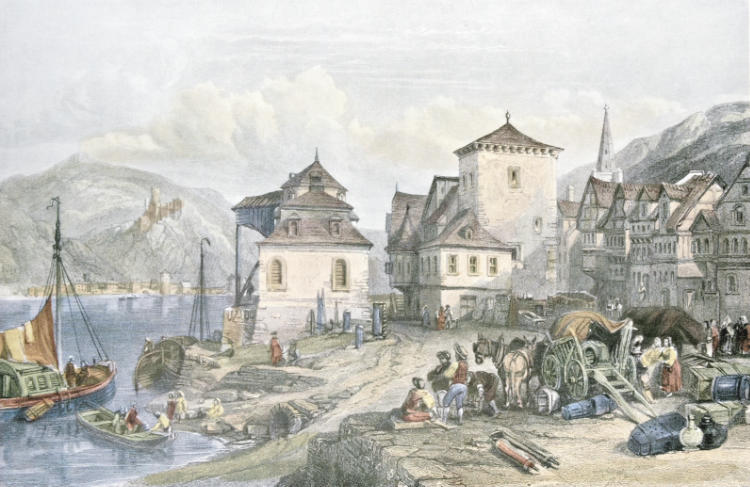
Since the 13th century, the toll tax on the Rhine has been collected in St. Goar under the protection of the Rheinfels. For this reason, the city was unsuccessfully besieged by the Rhinish City Union in 1255. The old customs house was built on the banks of the Rhine in the 14th century to collect the toll from the lord of the land. To secure the toll, a toll tower was located in the city wall next to the customs house.
Directly next to the customs house, a crane had been standing since the 15th century. With its help, the goods produced in St. Goar and its surroundings could be shipped and the goods offered by the merchants in St. Goar could be unloaded by the ships.
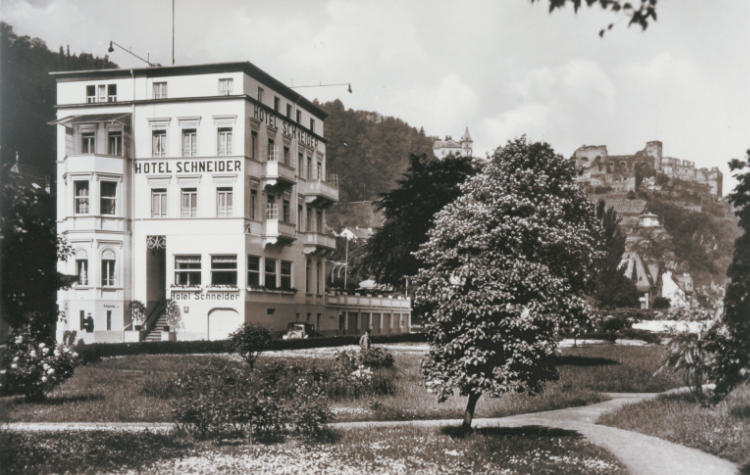
The 17th-century crane was for over 200 years one of the city’s landmarks. Together with the adjacent customs house, it adorns countless paintings from the Romanticism period. After it became no longer needed, it was demolished in 1869. In its place the ‚Hotel Schneider‘ was built on the banks of the Rhine, which quickly established itself as the leading hotel in St. Goar. Like the old customs house, it had to give way to the construction of Federal Road 9 in the 1930s of the last century.