
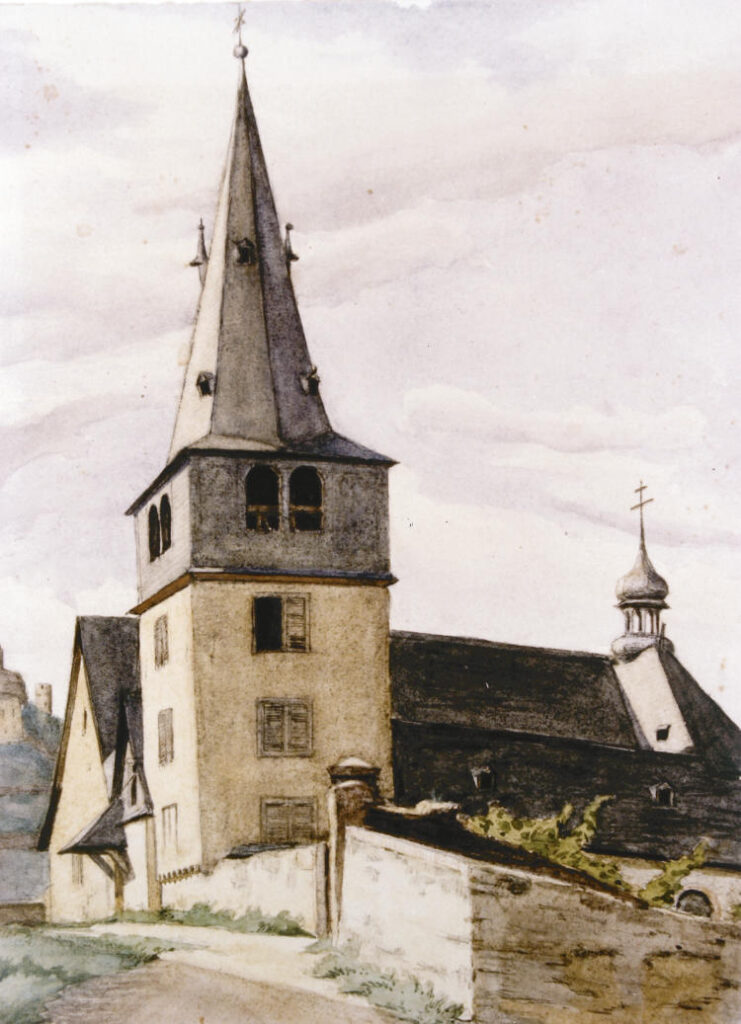
St. Goar was the first city on the Middle Rhine where the Reformation was introduced. For 125 years, there was no Roman Catholic rite in St. Goar. After Landgrave Ernst of Hesse-Rheinfels converted to Catholicism in 1652, the Jesuits began to practice Catholic pastoral care. The difficult and sensitive relationship between the Reformed Landgrave of Hesse-Kassel and the Catholic Landgrave of Hesse-Rheinfels was settled contractually in 1654. On this basis, the Catholics were able to begin building a church on the outskirts of the Reformed city of St. Goar in 1657. In 1658 the remains of Saint Goar were transferred to the newly built Catholic Church of St. Goar, as well as the cover plate of his tomb, which had previously been kept in the cathedral church.
The new Catholic Church of St. Goar was built in 1891 on the site of the dilapidated predecessor church as a neo-Gothic barrel-vaulted basilica with a transverse nave and choir. The Baroque tower serves as the bell tower; it remained part of the predecessor church and was connected directly to it by an extension of the church in 1923.
Inside the church, in addition to other art historical treasures, is the Gravestone of St. Goar from the 14th century, donated by Landgrave Ernst of Hesse-Rheinfels Communion bank with depictions of the Jesuit saints as well as one created around 1480 Late Gothic altar screen with paintings from the so-called ‚School of the House Masters‘.