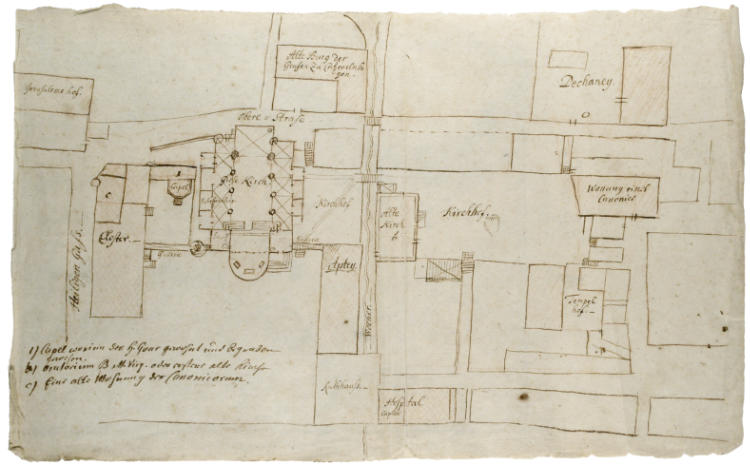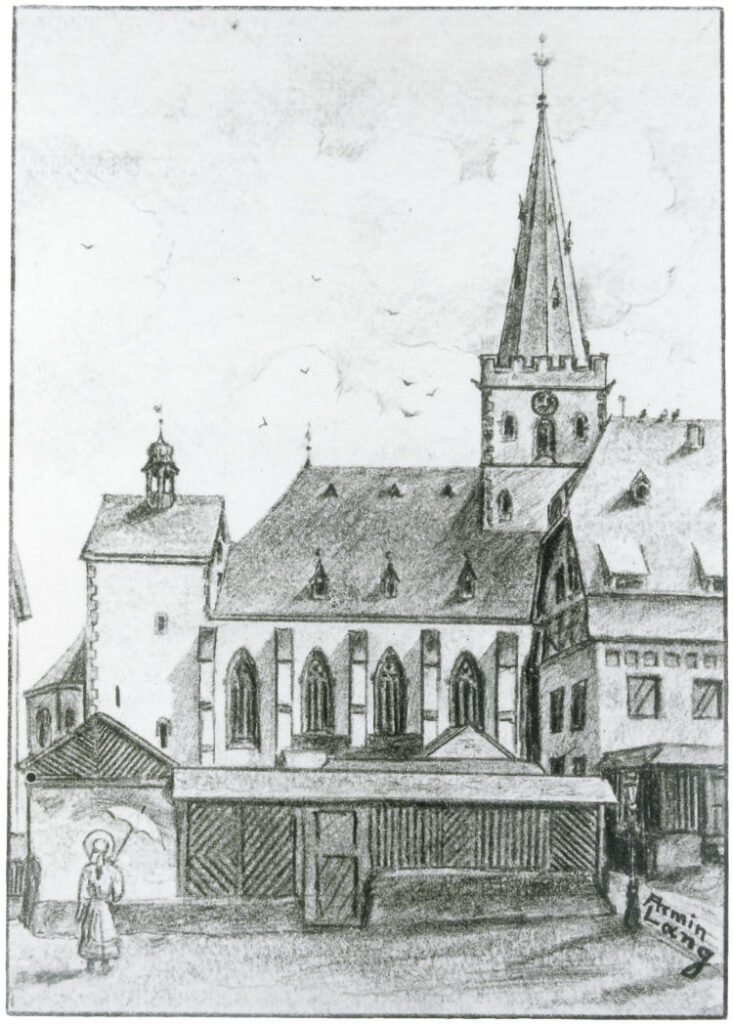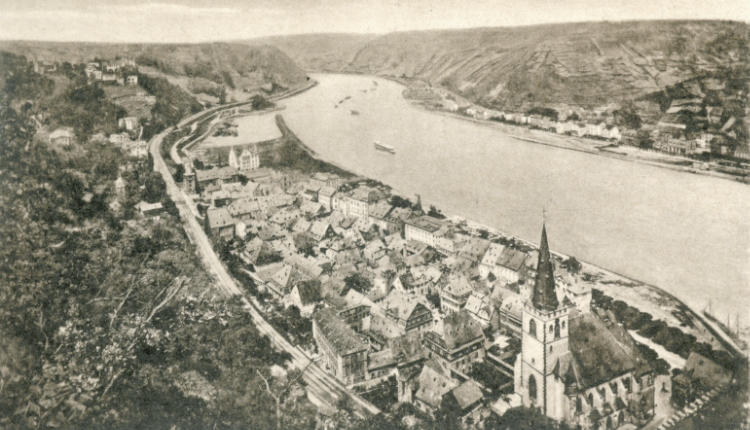
The Kirchplatz is a Remains of the sacred buildings and structures that were built around the cathedral during the Middle Ages. The square itself is part of the ‚Old Cemetery‘, the old cemetery of St. Goar. This was significantly larger than the current church square and extended from here to immediately adjacent to the church. The Wocherbach, which ran east of the church square, flowed through the churchyard in an open ditch and was spanned by a small bridge.
For almost 1000 years, a church stood on the grounds of the Kirchhof, the Oratory of Saint Mary. It was built long before the cathedral church; the chapel erected by Goar had become too small for the numerous pilgrims who made pilgrimages to his tomb. After no longer being able to hold services in this church due to its structural defects, it was demolished in 1772.
The old cemetery was largely opened for development in 1759. On its south and west sides, tanning plants were established, which continued until the 20th century. Here, leather was tanned, which was highly valued for its good quality and was widely exported.
The path from the church square leads to Gerstengasse to Heerstraße. It owes its name to the building that is now used as a residential house. Former „Gasthaus zur Gerste“ on the north edge of the Kirchplatz. Until the 19th century, Gerstengasse was called „Münzgasse“.“, Because next to the former inn stood the St. Goar coin. The own St. Goar currency, which was minted here, existed from the 13th century until the Thirty Years' War.